
INTERNATIONALLY KNOWN FOR NOSE REVISION SURGERY
Whether you are interested in a small tweak or a major revision, Drs. Solieman and Litner, double board-certified highly-specialized facial plastic surgeons, will fully analyze your condition, listen to your frustrations and explain what can be realistically achieved with your revision rhinoplasty. For more information, see the following link:
Revision rhinoplasty is an even more intricate, nuanced procedure than an original rhinoplasty. Oftentimes, the previous surgeon has removed or severely manipulated the underlying nasal cartilage. Having Drs. Solieman and Litner correct your functional nasal issues increases your chances of a highly satisfying result. This unique team approach is the reason Beverly Hills PROFILES is one of the leading rhinoplasty centers in the world.
Drs. Solieman and Litner will do their utmost to ensure that your first nose surgery with us is also your last. By working together, our surgeons are able to consistently achieve some of the highest success rates in the world.
Furthermore, we operate on patients who travel from other states and countries with a variety of cosmetic and functional problems. We work with each patient to accomplish the beautiful, natural look that is right for them.
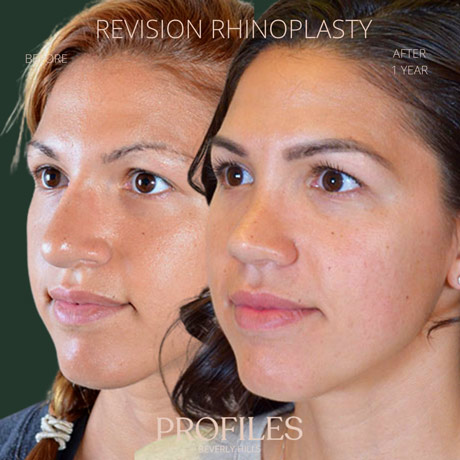
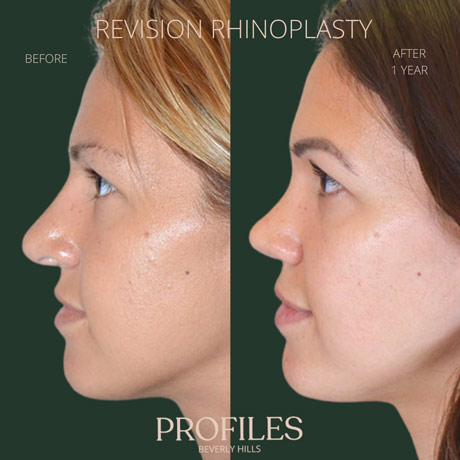
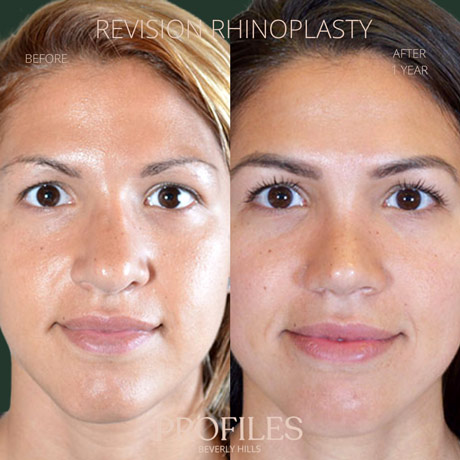
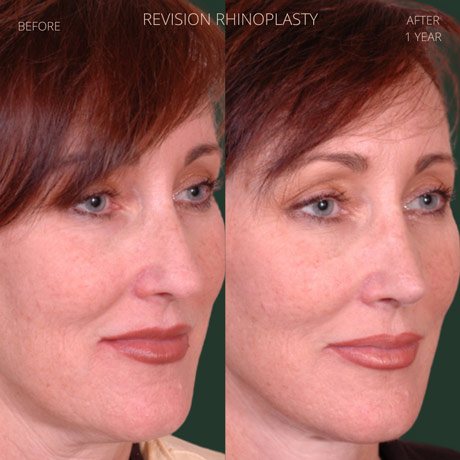
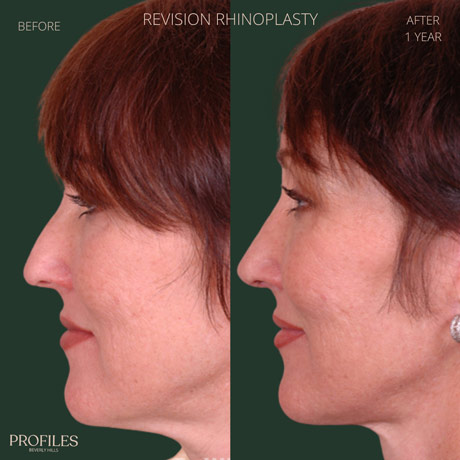
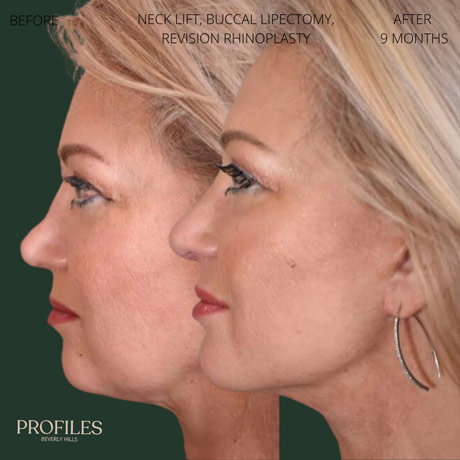
Feel free to browse through our revision rhinoplasty photo gallery. What you will find is that each patient’s results are unique and appropriate for him or her. Whether you come to PROFILES with an overly scooped out bridge, a crooked nose, or a deformed nasal tip, our surgeons will have the answer for you.
Our commitment to you begins with your first visit but that is not where it ends. Drs. Litner and Solieman follow up with you for years after your procedure to ensure that you not only get the nose you have always wanted but that it stays that way.
Like other cosmetic procedures, there are potential risks and temporary side-effects that come with revision rhinoplasty surgery. These include:
Drs. Litner and Solieman assess each patient, learn about their goals, and discuss the potential risks and possible side-effects prior to rhinoplasty surgery in order to set the right expectations.
A scooped-out profile is probably one of the most common problems we see after rhinoplasty. It usually occurs after routine reduction rhinoplasty when there was a bump on the bridge that was shaved down too much. This is particularly problematic when this occurs in men, as it is a feminizing feature.
A pollybeak deformity refers to a nose in which the area just above the tip is too full. When it is very full, it can make the nose look down-turned like a parrot’s beak, thus the name. Normally, there should be a little dip or depression just above your nasal tip that defines the transition from your bridge to your tip on profile. In a woman, that little dip is a feminizing feature.
A frequent problem after an overaggressive rhinoplasty is a tip that becomes distorted and lacking in support. This usually happens when too much of the tip cartilages are removed in trying to narrow and refine the tip. Instead, you just end up with a tip that is unstable. We have lumped these 3 rhinoplasty surgery problems together because they often occur together after a rhinoplasty in which the tip cartilages collapsed.
A frequent mistake seen after primary rhinoplasty surgery is a persistently over-projected tip. This means that the nasal tip still appears to stick out too far from your face. There are two reasons that this mistake is so common:
The first reason is that many rhinoplasty surgery patients are initially more concerned about their bump than anything else and are happy if the bump is all that is removed. Afterward, many patients realize that the tip still appears too prominent. The second reason is that technical maneuvers to reduce the nasal tip’s projection are more sophisticated. Many rhinoplasty surgeons were never trained in these maneuvers and simply do not perform them. Many surgeons have tried in the past but have experienced problems and now choose to avoid deprojecting the tip.
Think of the tip cartilages like a pair of wings. You can get an idea of what these look like from the rhinoplasty photos below. The cartilages are like a bent spring that hold the nostril’s shape, keeping it open to allow for normal breathing.
In many poorly done rhinoplasty surgeries, this cartilage is aggressively cut or removed so that it loses this natural spring. Over time, whatever cartilage is left starts to bend and twist under the weight of the skin. As the cartilage twists on itself, the weak points at the ‘joints’ of this cartilage can start to form bumps or knuckles, called bossae, that are very noticeable through the skin. Check out the diagram below to see what we mean.
There are two types of nasal valve collapses. The collapse of the tip cartilages described above can cause external valve collapse where the blockage is just past the nostril. However, when most rhinoplasty surgeons discuss valve collapse they are talking about internal valve collapse. This occurs when the upper lateral cartilages in the middle of the nose have been too narrowed. Take a look at the attached diagram to see where these are. This problem happens when a nasal bump is taken down too much and when the
The nasal bones are not so much like a pyramid but more like an arched covered bridge or tunnel. When a bump is made smaller, the top of the bones is shaved or cut shorter to reduce the bump. This leaves an opening in the roof of the bridge. That’s one of the reasons why we have to cut the base of the bones during rhinoplasty surgery (called osteotomies). We perform osteotomies in order to push the bones inward towards each other so that this opening can be closed.
The final rhinoplasty surgery mistake and problem we discuss is the twisted nose. A twist in the nose can happen anywhere from the nasal bones to the middle third of the nose and down to the tip. Getting a nose completely and perfectly straight is one of the hardest things to do in rhinoplasty and is especially hard in revision rhinoplasty. That is why you need to see an experienced rhinoplasty specialist like the Los Angeles rhinoplasty surgeons at Beverly Hills PROFILES.
Swelling may take up to twelve months to completely recede. However, there are many cases where a bad rhinoplasty may result in breathing problems, other functional issues, and visible deformities. These patients may be candidates for surgery after six months. It is best to consult with Drs. Litner and Solieman to find the best alternative.
You can be assured of person-centered care whether it be a virtual consultation, or an in-person visit to our Beverly Hills, LA offices. Our doctors will listen to your concerns, and discuss the various treatment options available to help you achieve your ideal nose.
They will also discuss the risks and side-effects of the various revision rhinoplasty treatment options available to you, ensuring complete confidence in their care and expertise.

ASK US ANY QUESTION